
Facilitation:
Workshops, Webinars, Consulting & Coaching
Facilitation: Workshops & Webinars
Tirian’s facilitation approach ensures that outcomes of meetings are effectively achieved, and the individuals involved maintain both ownership of the process and the outcomes. With a professional Tirian facilitator, meetings can move much faster and with less stress. Constructive dialogue can replace debating, and individuals can be carefully guided through each stage of the process. Most importantly, our facilitators use a holistic approach that considers the human dynamics that are at play during a process.
Our facilitator will help the team understand how to find more efficient processes to improve effectiveness. This process will empower all people at all levels and encouraging them to contribute to the creative development process, ensuring that individuals will become inspired and equipped for positive transformation. In the process participants will discover that it is possible to go beyond incremental improvements and impact a whole culture. Teams will also become much more engaged and proficient when they are encouraged to work on these processes collaboratively.
Facilitators provide stimulus to encourage the group to discover the answers. Since reflection is the key to deeper learning that leads to more lasting change, anything that a “facilitator” does to enhance reflection before, during, or after an experience is called “facilitation.”

Hypotheticals: Real-World Learning in Action
Our programs combine high-stakes simulations, case studies, and experiential learning to place leaders in the “hot seat” facing complex decisions, competing priorities, and incomplete information. Rather than discussing what leaders might do, participants test their judgement, critical thinking, and decision-making in realistic business scenarios.
Our Approach
- Real-Time Decision-Making: Leaders make and adapt decisions under pressure.
- Associative Thinking: Metaphors and diverse perspectives challenge routine thinking and unlock fresh insights.
- Human-in-the-Loop: Human judgement remains central to strategy, leadership, and AI-enabled decision-making.
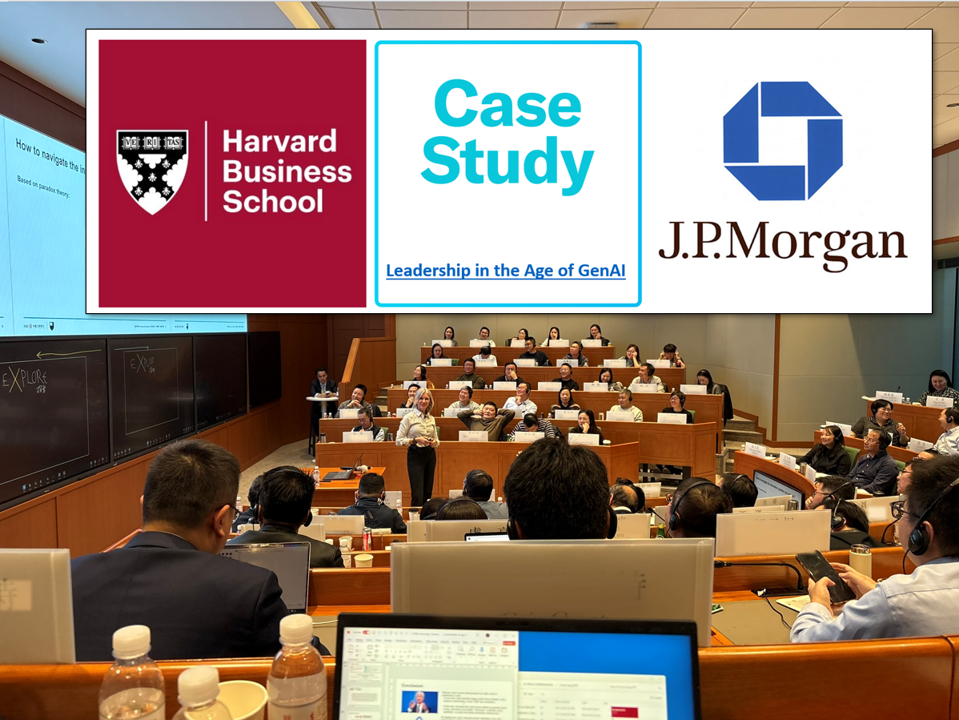
- Contemporary Case Studies: Programs may incorporate Tirian case studies, client scenarios, and selected published cases, including P&G: Cracking the China Code, The Hugging Face Incident: Critical Thinking in the Age of AI, and the Harvard Business School case study JPMorgan Chase: Leadership in the Age of GenAI, among others. MORE
- Executive Education Experience: Andrew Grant and Gaia Grant facilitate programs focused on critical thinking, innovation, ambidextrous leadership, and the strategic use of GenAI.
Andrew Grant and Gaia Grant have facilitated executive education programs for clients and partners of Harvard Business School, incorporating leading-edge practices in critical thinking, innovation, change leadership, ambidextrous leadership, and GenAI.
Selected third-party materials, including the Harvard Business School case study JPMorgan Chase: Leadership in the Age of GenAI, will require separate licensing or participant purchase. All rights remain with their respective owners. Use of such materials does not imply endorsement, sponsorship, or affiliation with Tirian.
Facilitation: Consulting & Coaching

Tirian’s coaching and facilitation focus on the human side of organisational performance, leadership development, culture change, and transformation. We help leaders and teams strengthen leadership effectiveness, innovation, critical thinking, collaboration, decision-making, change leadership, stakeholder engagement, and future readiness. Our approach combines organisational psychology, leadership dynamics, ethnographic research, and evidence-based frameworks to deliver sustainable behavioural change, team effectiveness, organisational capability, and business performance outcomes.
Typical outcomes include:
- Stronger leadership capability and confidence
- Greater collaboration, trust, and stakeholder alignment
- Improved innovation, problem-solving, and decision-making
- Enhanced readiness for change and transformation
- Increased engagement, resilience, and adaptability
- Sustainable behavioural change translated into workplace performance and business outcomes
WHAT’S THE DIFFERENCE? We can offer the following methods of development: Facilitation, consultation, & coaching
- The facilitator’s main aim is to help the group increase effectiveness by improving processes and structure.
- Process: refers to how a group works together, talks to each other, identifies and solve problems, makes decisions and handles conflict.
- Structure: refers to stable recurring group processes dynamics and roles.
- Content: refers to what the group is working on. The facilitator does not need to be a content expert and should remain neutral. The facilitator’s role is to bring out the expertise in the group.
- In a pure facilitation session, the facilitator should not be to seek to change people’s behaviour, but to provide feedback that enables people to decide whether to change their own behaviour, and should they decide, be the facilitator can help them learn how to change (and or add in a coaching element).
- A consultant provides their expertise to the group
- A coach seeks to change behaviour