
Behind Successful Design & AI integration


OVERVIEW: AI-specific focus areas to consider when engaging a Tirian program (Keynote / Workshop / Strategy / Team Building)
AI in Action: From Conceptual Framing to Strategic Tool Focus Areas. We don’t view AI as just another skill to be taught. We see it as a transformational lens—one that can amplify human ingenuity, challenge assumptions, and reveal new pathways to solve complex problems. But only if it’s introduced in a way that aligns with how people think, learn, and lead. This means the technology doesn’t hijack the conversation; it enhances it.
As AI accelerates across industries, leadership development faces a critical question: How do we integrate AI meaningfully into learning—without letting it overshadow the human experience? At Tirian, we believe AI should amplify strategic thinking, deepen reflection, and spark innovation—not derail sessions into tool training. That’s why we’ve designed a multi-framework approach for activating AI in workshops that aligns with diverse audience needs, organizational goals, and the ever-evolving AI landscape.
Focus Area 1: Framing AI Conceptually
A Tiered Approach to Meaningful Integration in Leadership Workshops: This is our primary focus. Instead of diving into the mechanics of tools, we introduce AI as a strategic enabler—a lens through which participants explore the workshop’s key themes (creativity, innovation, leadership). Every Tirian program now includes AI-aligned debrief questions, anchoring conversation in relevance rather than technical fluency. This keeps the experience inclusive, thought-provoking, and grounded in human ingenuity. Through guided discussion and immersive simulations, during any of our sessions, we can focus on and surface questions like:

TOPICS COVERED CAN INCLUDE:
TOPICS COVERED CAN INCLUDE:
- Does every company now need to become a tech (Gen-AI) company?
- Why a Pre-Strategy Workshop Might be the Most Strategic Move You Make
- How to Future-Proof in a Digitally Intelligent Age:
- How can leaders navigate the Paradox of Progress and Precaution in an AI-driven world?
- What tensions does AI amplify in leadership today?
- How fast can AI transform us before we crash and burn?
- Is AI MAD (mutually assured destruction)? Game Theory and Collaboration
EXAMPLE:
JPMorganChase: Leadership in the Age of GenAI
- This Case Study Topic highlights how executives can lead and implement generative AI through ambidextrous leadership—balancing exploration and exploitation—to transform decision‑making and organizational strategy.…
- The Case Study Method engages participants in a highly interactive live analysis of real-world business dilemmas through structured discussion, debate, and decision‑making to develop practical insights and leadership skills.
(more about the Harvard Case Study Method)… - Dr Gaia Grant /Andrew Grant have facilitated executive education programs in partnership with institutions including:
Harvard Business School, Duke Corporate Education, Sydney University Business School, and Miami University.
– Integrate this case study session with a full workshop experience: Leading Innovation on the Edge: Navigating the AI Adoption Divide
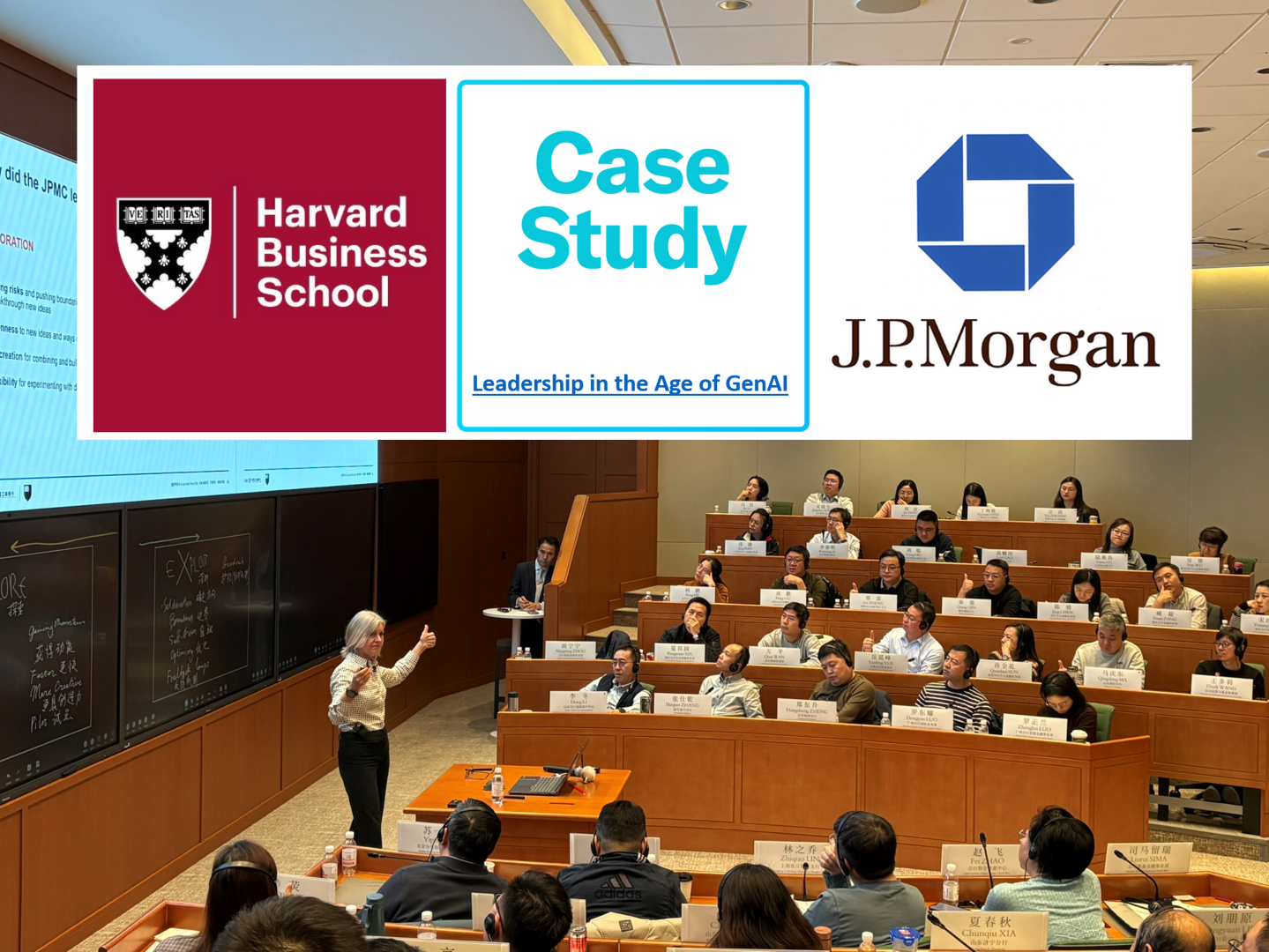
Dr Gaia Grant (PhD) and Andrew Grant can deliver this Harvard Business School case study, using the Case Study method, guiding executives through structured analysis and discussion to generate actionable insights.
Focus Area 2: Using AI Tools to Strategically Solve Problems
When the context calls for hands-on use, we take a light-touch, exploratory approach. Participants are invited to use generalist tools like ChatGPT, Gemini, Copilot, or Perplexity—but without formal instruction. The emphasis remains on strategic thinking and problem-solving, not tool mastery.
This preserves session flow and ensures that facilitators aren’t pulled into the weeds of software training—keeping the learning experience cohesive and accessible across skill levels.
Big Picture Framing Program examples:
- In CSI1 – Creative Quotient, and CSI2 Design Thinking programs: participants test ideation using LLMs to solve case studies.
- In The Chocolate Factory gamified simulation, they redesign engagement strategies with AI-enabled thinking.
- In The Innovation suite, participants use AI to explore best practices of case studies and develop strategic approaches for the organisation.

In The Chocolate Factory gamified simulation, participants redesign engagement strategies with AI-enabled ideas.
Choose when to Use! Ask what the outcomes of the workshop are?
A) DO WE NEED INTERVENTIONS DESIGNED FOR PERSONAL DEVELOPMENT AND DEEP UNDERSTANDING OF THE CHALLENGES?
- If the goal is to help participants deeply engage with the challenges presented in the workshop and gamified simulation (such has the using CQ to develop personal creativity, help with process redesign, employee engagement, and customer centricity)—while fostering personal creativity and proactive problem-solving—then group discussions should remain human-centered. Research shows that “brain-only” writing activates deeper memory, executive functioning, and creativity.
- Conversely, as AI/LLMs become more “original,” overreliance on them may reduce user creativity and critical thinking, leading to cognitive offloading or decline.
- Research also shows that people who rely on AI too much, and too quickly, fail to have a deep understanding of the issues. This defeats one of the main learning practices and the purpose of the workshop.
B) DO WE NEED INTERVENTIONS DESIGNED FOR FAST SOLUTIONS?
- However, if the focus shifts toward generating solutions to the problems surfaced by the session, then collaborative use of AI/LLMs can be valuable.
- Participants might benefit from using AI tools as part of their redesign process.
- It’s important to recognize that AI fluency is a linear learning journey, and participant expertise will vary widely. In this scenario, it’s best to present the big picture of AI’s potential, then let each person engage at their own level using the models they’re comfortable with.
At Tirian, we’re not preparing leaders to master AI tools., we’re preparing them to ask better questions, challenge assumptions, and lead through uncertainty—with or without a chatbot by their side.


Option 3: Using AI Tools for Targeted Instructional On-Ramping
For more technical training, facilitators may introduce AI tools at a more tailored level. However, Tirian does not provide in-depth technical training. Genuine AI fluency requires specialist expertise, evolves rapidly, and varies widely across industries. To avoid misalignment or ineffective facilitation, this approach should only be used when the facilitator has expertise equal to or greater than the group and when participants form a homogeneous group, all requiring the same level of content. This is not just a facilitation decision — it’s a strategic consideration that also shapes sales conversations and proposal alignment.
Staying Focussed- What we don’t offer is as important as what we do offer!

Why This Matters: Framing the Future Without Getting Lost in the Tech
The velocity of AI advancement is undeniable—but speed alone doesn’t equate to readiness. Leaders today don’t just need to understand the tools; they need to develop the mindset to navigate what those tools make possible. Teaching the technical mechanics of AI is a short-term fix. Building curiosity, adaptability, and strategic confidence—that’s what enables long-term leadership resilience.
When AI becomes a metaphor for adaptability, not an obstacle of complexity, leaders become better equipped to embrace change—not just react to it. That’s the difference between learning a tool… and learning to lead in an AI-shaped world.


Crossing the Finish Line Without Running the Race: The Illusion of AI Success
While AI promises speed and efficiency, it can easily become a shortcut that undermines the deeper purpose of experiential learning. Jumping on the AI bandwagon without strategic intent is like driving from A to B in a fitness challenge and claiming victory—missing the point entirely. At Tirian, we challenge this mindset by aligning AI use with authentic outcomes. Whether in team building or creative thinking, the goal isn’t just to get a result—it’s to test dynamics, foster insight, and build capability. That’s why we always start by clarifying client expectations and designing AI integration that enhances, not replaces, the human experience.

See our latest articles covering our approach and ideas about AI-
Does every company today, need to become a tech AI-driven company?