
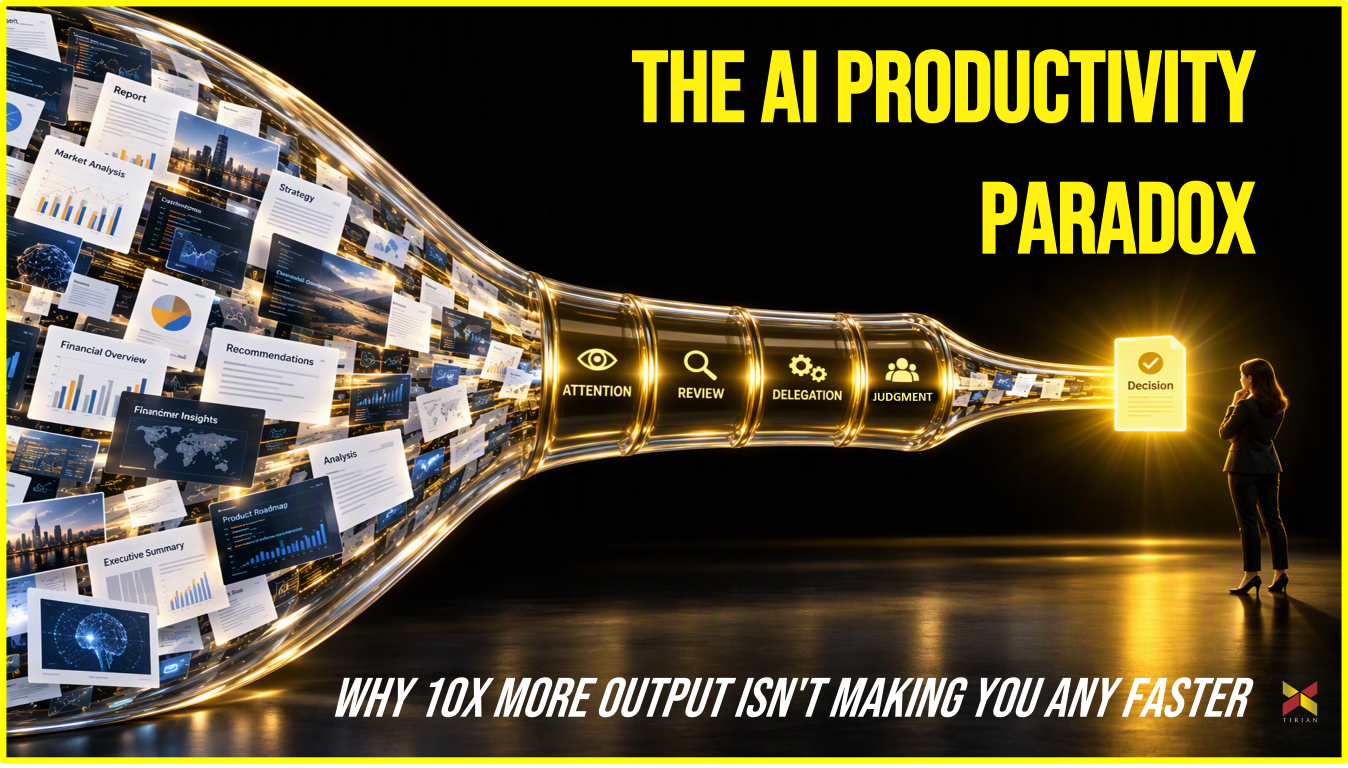
Four Bottlenecks that AI Cannot Solve
Overcoming AI Productivity Bottlenecks
Many are asking: How much productivity will AI unlock? While adoption is widespread, organizations are discovering new AI productivity bottlenecks that technology alone cannot solve.
It’s a reasonable question. AI can now generate reports, analyze data, draft presentations, write proposals, summarise meetings and produce recommendations in seconds. Tasks that once took hours can often be completed in minutes. Yet at the same time, an interesting paradox is also emerging.

AI Productivity Bottlenecks: Why Output Doesn’t Equal Speed?
Research published in Firm Data on AI – based on a survey of nearly 9,000 CEOs, CFOs and senior executives across seven countries – found that 78% of firms are already using AI. But despite that widespread adoption, executives estimated AI had increased labor productivity by only around 0.2% per year over the previous three years.
That doesn’t mean AI lacks value. In fact, findings from the same research suggest leaders expect much larger gains as adoption matures. But it does raise an important question:
If AI is creating so much more output, why are the gains still relatively modest?
We suspect the answer has less to do with AI’s capabilities and more to do with the new constraints it creates.
For decades, organizations were constrained by access to information and the ability to produce output. If you wanted more analysis, more reports, more options or more recommendations, somebody had to create them.
Today, AI can do much of that almost instantly. The challenge is that while output scales, people don’t. And the result is a new set of bottlenecks. These bottlenecks are far more human than technological, and they require creative and critical thinking.
The First Bottleneck: Attention
In the age of AI, the “bottleneck” observation feels less like an insight and more like a warning.
Most professionals aren’t struggling because they lack information. They’re struggling because there is now too much of it. Every day brings another dashboard, another report, another meeting summary, another recommendation and another AI-generated insight demanding attention.

More information does not solve the problem – it often deepens it. As Nobel Prize winner Herbert Simon noted: “A wealth of information creates a poverty of attention.”
The challenge is no longer finding information. The challenge is deciding what deserves attention. Ironically, as AI gets better at generating answers, our ability to focus on crafting the right questions and identifying the right output becomes more valuable.
The leaders who thrive won’t necessarily be those with access to the most information. They’ll be the ones who know what to pay attention to and what to ignore.
The Second Bottleneck: Review
Now imagine every employee has not one AI assistant, but five or ten. Each agent can research, draft, analyze, summarize and recommend. On the surface, this sounds like the next productivity revolution. But there is an obvious problem.
Who reviews the work? As AI scales output, the volume of information, decisions and recommendations grows exponentially. Human review capacity does not.

More content does not reduce the need for review – it multiplies it. As the old Russian proverb reminds us: “Trust, but verify.”
If AI gave you ten times more information tomorrow, would you review ten times more information? Probably not.
At some point, output stops being the constraint and scrutiny becomes the constraint.
The ability to evaluate, validate and challenge information may become more important than the ability to generate it.
The Third Bottleneck: Delegation
The next shift is even more significant. We’re moving from AI that helps us think to AI that helps us act. Agents can increasingly communicate, negotiate, make decisions and take action for us without direct human intervention.
The question is therefore no longer: Can AI do it? The question instead needs to be: Should AI do it?

Delegating work does not delegate responsibility. As management thinker Peter Drucker observed: “Management is doing things right; leadership is doing the right things.”
Every decision to delegate work to an AI agent is ultimately a judgment about risk. The greater the consequences, the greater the need for oversight. Because while delegation scales remarkably well, accountability doesn’t.
Someone still owns the outcome. Someone still carries the responsibility when things go wrong. The technology may act. The human remains accountable.
The Fourth Bottleneck: Judgment
Which leads to the biggest bottleneck of all.
If AI can increasingly generate content, perform analysis, conduct research and produce recommendations – what becomes more valuable?
The answer isn’t more information. It’s judgment – or the ability to:
- Interpret context.
- Challenge assumptions.
- Navigate ambiguity.
- Make decisions when there is no obvious answer.
- Accept accountability for outcomes.
Interestingly, this is also where workforce trends appear to be heading. In the HR Monitor 2026: A Turning Point for the People Function, McKinsey & Company identified growing demand for capabilities such as problem-solving, creativity, reasoning, resilience and digital literacy. These are not routine task skills. They are higher-order cognitive capabilities.

In other words, as AI becomes better at doing work, organizations increasingly value people who can reason independently.
That presents a challenge for all of us. Many professionals are still investing heavily in the skills that got them hired. The bigger question is whether we are now investing enough in the skills that will keep us valuable.
Because in an AI-enabled future, the differentiator may not be how much output you can produce. It may be how well you exercise judgment.

When every employee has 10 agents, output scales exponentially – but accountability doesn’t. The challenge shifts from creating work to reviewing, directing and judging it.
The Real Competitive Advantage
Perhaps the competitive advantage of the future won’t be access to better information. Perhaps it will be knowing what deserves attention, what deserves scrutiny, what deserves approval, and where human judgment still matters most.
Four Questions to Address the Bottlenecks
1. Attention: What deserves focus?
- What currently consumes your attention without creating value?
- What deserves more of your attention, and what deserves less?
- How will you know?
2. Review: What deserves scrutiny?
- If AI gave you 10× more information tomorrow, how would you decide what to ignore?
- What criteria would determine what deserves your attention and review?
3. Delegation: What deserves approval?
- What decisions are you willing to delegate to an AI agent?
- Which decisions must remain human?
- What is the cost of getting that decision wrong?
4. Judgment: What deserves human expertise?
- How are you developing the skills that will keep you valuable in an AI-enabled future, not just the skills that got you hired?
- How will you measure and demonstrate that?
Critical Thinking Workshops
Interested in building stronger critical thinking capabilities across your team?
This topic is covered in our Critical Thinking Investigation: AI Edition
Available as a: Keynote | Workshop | Business Facilitation

Delivered for organisations including KPMG, Toyota and ANZ Bank.

Example client materials shown. Our workshops can be customised to reflect each client’s branding, business challenges and strategic objectives. All trademarks remain the property of their respective owners.