
Innovation Readiness Diagnostics: Academically Validated Roadmaps for Strategic Transformation
Future-Ready Leadership Assessments: Measuring Change Agility and Innovation Mindsets for the Agentic Age
Drive systemic transformation with academically validated diagnostics designed to assess leadership alignment and organizational health. Our proprietary suite—featuring the Innovative Change Leader Inventory (iCLi) and the Innovation Climate Index (iCi)—measures the individual biases and environmental blocks that either fuel or stifle growth. By utilizing these research-backed tools, including the comprehensive iCLi 360, leaders identify strategic gaps, facilitate cultural integration, and leverage modern catalysts like AI to turn complex business challenges into quantifiable results.
1. INDIVIDUAL Innovative Change Leader Inventory (iCLi):

2. TEAM Innovation Climate Index (iCi)

3. ORGANISATION Innovation Climate Index (iCi)

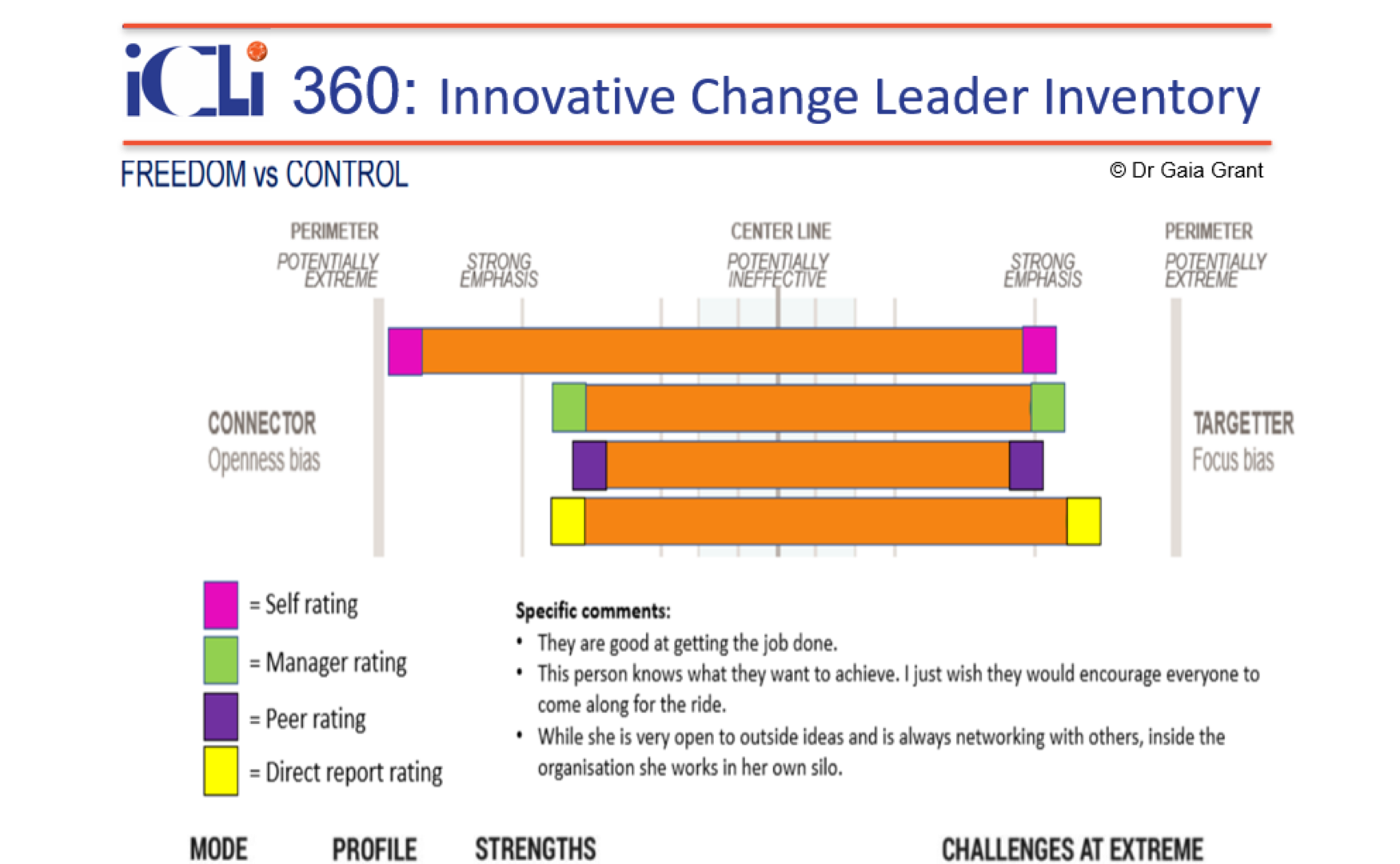
4. iCLi 360: Seeing Leadership Through a Wider Lens

Become an Accredited iCLI Coach.
The Future-Ready Leadership Coaching Program Training course is designed to prepare coaches and leaders for delivering feedback on the Innovation Change Leadership (iCLi) profile measure. This coaching training course is ideal for developing skills for coaching and leading as a coach within the organisation, as well as for independent coaches to use in a commercial coaching context. (full licencing also available).
Validity: Developing and applying a multidimensional measure of paradoxical innovation leadership orientations:
Presented at the 35th European Group for Organizational Studies (EGOS) Colloquium 2019 Edinburgh, Scotland. Dr Gaia Grant, University of Sydney / Prof Martin Dowson, Excelsia College. Keywords: Innovation Paradox; Innovation Management and Leadership; Innovation Measurement; Change Leadership; Leadership Ambidexterity.
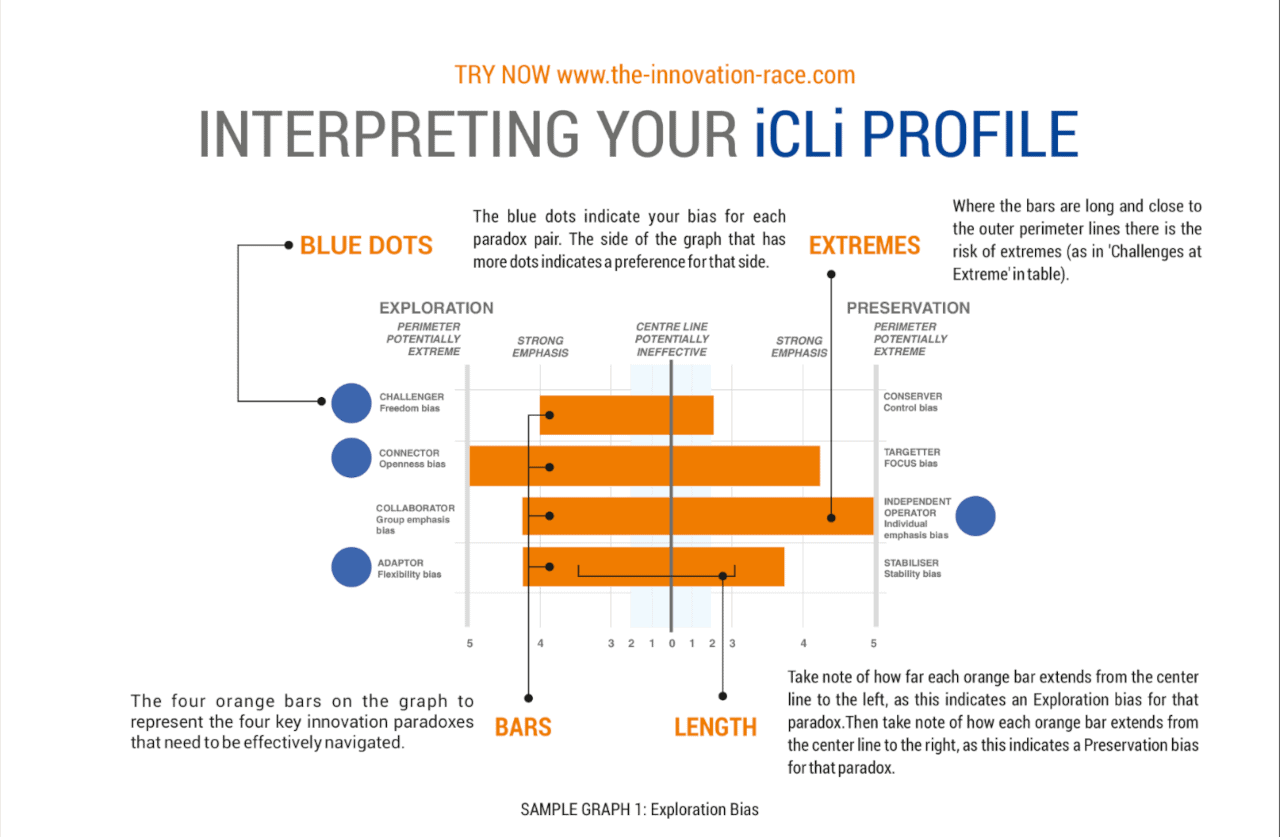
Rapid change in complex contemporary environments leads to the need for organizations to innovate in order to survive. Ironically, though, complex environments give rise to inherent ambiguities and related tensions that make it difficult to lead innovation effectively. These tensions are related to dichotomies or dualities that are inherent in change. Leaders need to be able to recognise and address these tensions to deal with complexity and rapid change at all levels, and to manage innovation strategically. This research focuses on the identification and investigation of a specific tension that can negatively impact innovation leadership if not addressed effectively.
Recent research indicates that ambidexterity may assist with managing paradoxical tensions related to innovation leadership. Yet little is known about how ambidexterity works in practice nor how it might be developed for leaders. This research includes a series of three studies that identify paradoxical orientations that can impact ambidexterity and innovation leadership. One key aim of the research was to develop a psychometrically and contextually valid multidimensional measure of paradoxical innovation leadership orientations. This aim was supported by qualitative data gathered from semi-structured individual interviews with 66 innovation leaders. The instrument was then developed using quantitative data from 974 participants, and a replication study using quantitative data from 118 innovation leaders was also conducted. The research indicated that the paradoxical innovation leadership orientations were comprised of four paired dimensions, and the instrument developed to measure these orientations displayed sound psychometric properties. Further, the application of the instrument with various occupational groupings was tested in quantitative studies, which supported both the theoretical integrity and the occupational applicability of the instrument. The interrelated studies reported in this paper address a gap in the research related to the identification and application of key paradoxical dimensions associated with innovation leadership.”
Practitioner Points
- Ambidextrous leadership approaches support both adaptation and maintenance functions in organisations for innovation sustainability, and identifying and managing paradoxical tensions in innovation contexts has been found to facilitate ambidexterity.
- This study identified paradoxical innovation leadership orientations that impact ambidexterity, and established that these orientations are comprised of nested dimensional pairings.
- The dimensional pairings were validly measured by a new psychometric instrument, and were identified as being hierarchically arranged and causally ordered.
- The dimensional profile of occupational groupings was found to be consistent with underlying theory.
Contact us for the full PDF paper.