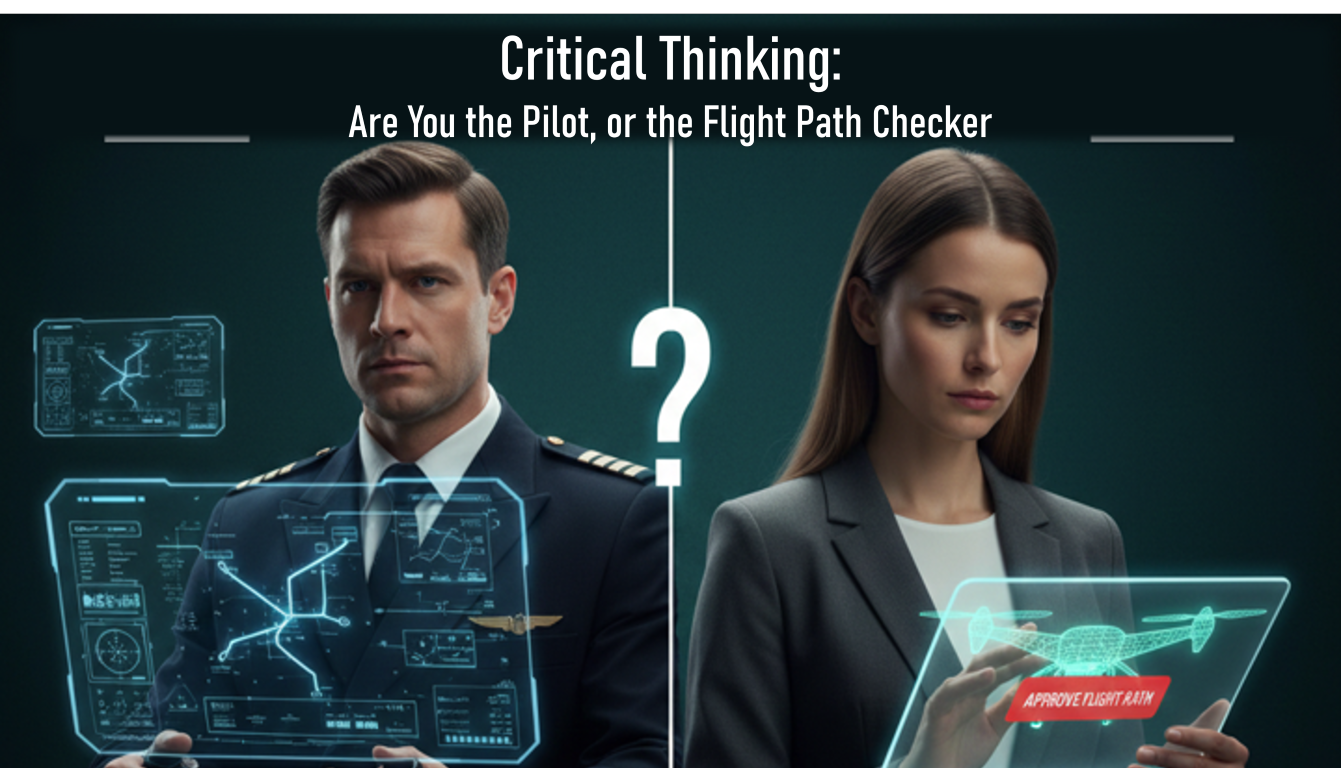
Are You the Pilot, the Flight Path Checker, or the Passenger?
If your primary value has come down to validating a robot’s opinions, how long will it be before your company realizes they only need the robot?
For years, we’ve conducted forensic inquiries for leaders and their teams. The approach we developed has been designed as an investigation into the stagnation and decline of independent cognition.
We’ve noticed this is becoming more prevalent. When we remove leaders from their support systems and address them directly, they often struggle to access their critical and creative thinking capabilities.
Our work with a global operations client revealed that, when executive leaders were asked to cut the budget by hundreds of millions of dollars, they initially proposed standard solutions. These solutions were short-term fixes to address a specific dilemma, rather than insightful solutions that addressed the core paradoxical tensions.
It is often only through a series of ‘cognitive stretch’ exercises that we can teach our clients how to tap into and develop the cognitive reserves we all have.
This decline in cognitive thinking was documented long before “generative AI” became a household term. Today, the contrast is even more stark. The culprit can’t simply be identified as corporate bureaucracy or risk aversion, it’s clearly become the seductive ease of outsourced thinking.
The Rise of the Human Filter
We are entering an era of information hyper-abundance. AI makes it nearly free to produce text, code, and images, but it does so without context, consequence, or intent. In this flood of cheap information and intelligence, creative and critical thinking have shifted from soft skills to survival mechanisms. Yet these are currently the only things that separate coherence from true originality and truth itself.
We can easily fall victim to cognitive offloading. Our brains are wired for ease, and AI provides the ultimate shortcut. But just as a GPS can erode our innate sense of direction, over-reliance on AI makes us worse at “brain things.” We are essentially inventing a cure for exercise and then wondering why we are out of breath the moment a complex, human-shaped problem hits our desk.
The Participation Paradox & AI
We are currently witnessing a period I am calling the participation paradox. As we integrate AI into our workflows, we gain unprecedented efficiency, but we may pay for it by sacrificing cognitive capacity.
In his recent TED talk, researcher Advait Sarkar (Microsoft) echoed a sentiment that strikes at the heart of our research. Sarkar believes we have become “intellectual tourists” in our own work. We visit ideas through AI-generated summaries, he says, and we no longer inhabit them through the struggle of creation and critical analysis.
When we outsource the heavy lifting of thinking, we can fall into a validation trap. We stop being pilots and start acting as middle managers of our own thoughts, or flight path checkers, merely staring at a page that an AI filled out for us and wondering if we have enough critical capacity left to even disagree with it.
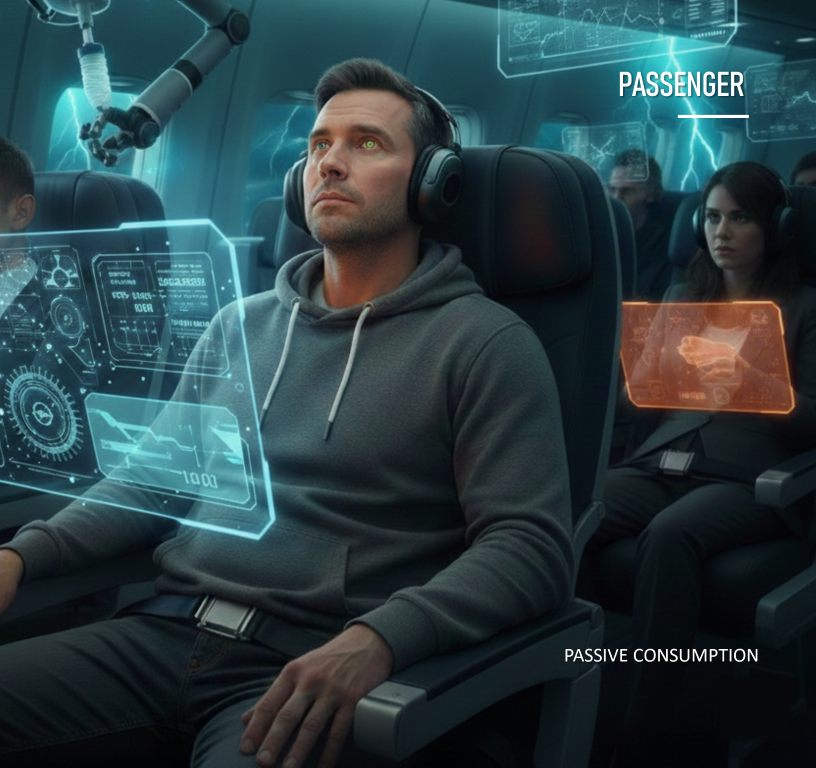
At the extreme, we can simply become a passenger on the journey, with no cognitive agency or control over the flight path. This involves accepting only the information provided, without asking how or why. There is no situational awareness, and can lead to being oblivious to contextual shifts. It can also result in operational blindness, where there is a default to passive consumption rather than active control.
A Model for Cognitive Agency
To stay in the top 10% of thinkers – which is the only group predicted to “beat” the machine – we must shift from using AI as an assistant to using it as a tool for better leveraging our own thinking. This requires four strategic pivots:
- Demand Productive Resistance: Stop asking for summaries that may make you lazy. Demand provocations that challenge your logic.
- Move from Generator to Architect: AI can calculate the flight path, but you must provide the abstract reasoning and moral compass to frame and oversee the journey.
- Escape the Boring Hive: When everyone uses the same prompts, collective creativity plummets into a hive mind of identical outputs. Originality requires material engagement.
- Prioritize Process over Speed: The goal shouldn’t be just to get the job done faster, it needs to be to utilize the process to understand and approach the job better.
The Critical Pivot
If your primary value today is validating a robot’s opinions, you aren’t future-proofing your career. You’re documenting your own obsolescence.
AI’s role should be to challenge, not simply instruct or obey.

TO CONSIDER: When you opened your laptop this morning, did you step into the cockpit as the pilot or a flight path checker, or did you simply check in as a passenger, embarking on a flight path you didn’t plan and you don’t control?
CHALLENGE QUESTIONS TO ASK YOURSELF
Provocative Starter Questions
- The Week-Long Blackout: If your AI access was cut off for a week, would you still be the smartest person in your role, or has your expertise migrated to the server?
- The 90/10 Split: We’re told the top 10% of thinkers will thrive while the 90% are replaced. On a scale of 1-10, how much of your workday is spent doing ‘Pilot’ work versus ‘Flight Path Checking’?
- The Writer’s Block Lie: Is writer’s block actually a ‘lack of ideas,’ or is it the brain’s healthy way of forcing us to inhabit the material? By using AI to overcome the block, are we also missing the growth opportunities?
Culture & Management Starter Questions
- The Boring Hive: Have you noticed a sameness in the reports and decks landing on your desk lately? How do you incentivize ‘productive resistance’ in teams that are currently being measured solely on speed?
- The Junior Talent Crisis: If senior leaders use AI to do grunt work, how do junior employees build the cognitive strength they need to one day become the Pilots?
Personal Workflow Starter Questions
- The Validation Trap: Be honest. When was the last time you truly disagreed with an AI suggestion and rewrote it from scratch? Are you simply becoming a ‘middle manager’ of robot opinions?
- The Efficiency Tax: We’ve gained hours of free time through AI efficiency. What are you doing with that ‘saved’ time? Are you using it to think more deeply, or just to do more superficial work?
- The ‘Gotcha’ Prompt: Instead of asking AI to ‘Write this for me,’ try asking it to ‘Find the three weakest points in my argument.’ How would that change your relationship with the tool?
Human Edge Starter Questions
- The Experiential Gap: What is one ‘human-shaped’ problem in your industry that an LLM will never be able to solve, no matter how much data it has?
- The Exercise Paradox: If AI is a ‘cure for exercise,’ what is your personal ‘mental gym’ routine to stay intellectually fit?
Book | Keynote | Workshop on Creative & Critical Thinking
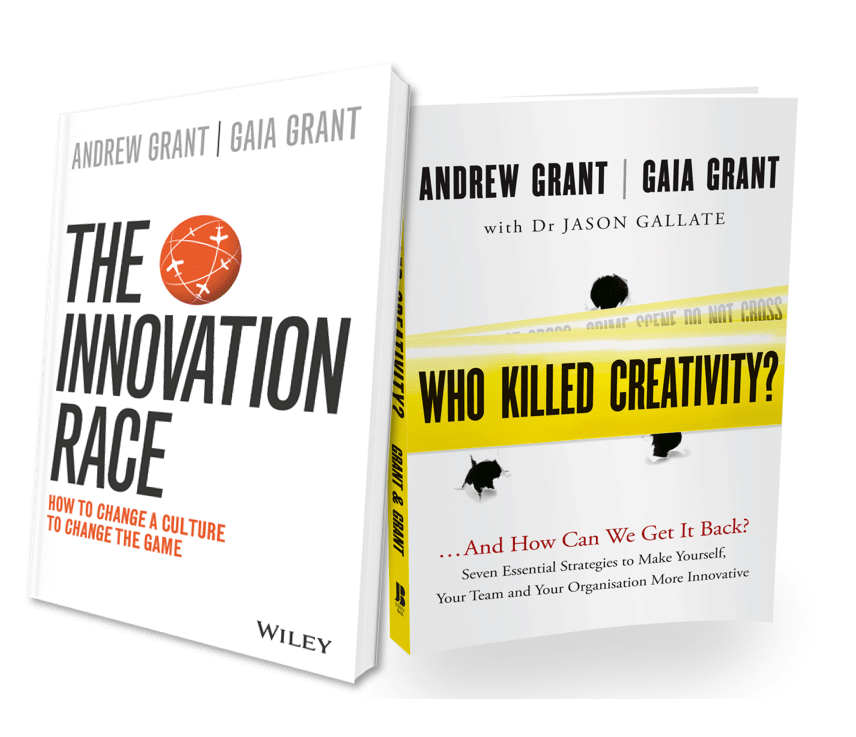
While the landscape of AI evolves by the second, the neuroscience of the human brain remains constant. And that is why Who Killed Creativity? is more critical entering its second decade than the day it was written. AI hasn’t solved our creative crisis – it has simply supercharged the ‘creative and critical thinking killer’ suspects, giving the unscrupulous or unreflective user a seductive shortcut to bypass the mental workout required for original and analytical thought. To become a pilot capable of abstract reasoning, to move beyond being a flight path checker who simply validates robot output or even a passenger, you must understand the unchanging biological foundation of how we think, struggle, and ultimately innovate.
- The Pilot’s Paradox: Outsourced Critical Thinking: comment, bookmark & share this article: Tirian | LinkedIn | Substack
- See how we Position AI in our Keynotes and Workshops:
- Engage us to Run a Creative & Critical Thinking keynote / workshop on the above topic: https://tirian.com/key-topic-suites/create/
- The AI Critical Thinking Lab: An Essential Masterclass Addendum. In this specialized extension, leaders & teams will:
- Audit Cognitive Strength: Identify where efficiency has led to cognitive atrophy, and reintroduce the creative and critical thinking required for deeper job mastery.
- Shift from Passenger to Pilot: Shift from simply approving robot output to applying the rigorous abstract reasoning and critical thinking required for real-world solutions.
- Leverage AI as a Co-Pilot: Develop strategies to use AI as a collaborator that enhances human ingenuity rather than replacing it.
VIDEO & AUDIO OVERVIEWS:
Stop Being an Intellectual Tourist: How to Beat the AI “Hive Mind” using Critical Thinking Skills. These Video & Audio overviews break down the Model for Cognitive Agency—a framework to ensure you are the one framing the journey, not just following a flight path you didn’t plan and don’t control.
- Watch the YouTube Video 6 mins video graphic
- Listen to the Audio Overview 30min (Spotify / Substack)