
Critical Thinking as a Competitive Advantage: Navigating the GenAI Era
When speed is a commodity, human judgment is the only true differentiator. It is time to stop flying on autopilot and reclaim your strategic agency.
PART 1: AI Can Predict, But Only Humans Can Decide
In January 2009, US Airways Flight 1549 lifted off from New York’s LaGuardia Airport on what should have been an ordinary, uneventful climb. Minutes later a flock of geese struck the aircraft, disabling both engines. In the cockpit alarms sounded, screens flashed, and the automated systems began calculating the “optimal” return routes to LaGuardia or diversion paths to Teterboro. Air Traffic Control reinforced those options, urging the pilots to follow the system’s recommendations.
But Captain Chesley “Sully” Sullenberger saw something the computers couldn’t: the real‑time loss of altitude, the diminishing airspeed, the narrowing window for action. The system was offering possibilities while he was assessing probabilities. And in that gap between calculation and context, he made the call to override every automated instruction and land the plane on the Hudson River. His ability to judge the situation according to the context meant that all 155 people survived.
That moment wasn’t a triumph of technology, it was a triumph of critical thinking. Sully didn’t reject the system – he interrogated it. He understood its limits. He recognized that in complex, high‑stakes environments, blind trust in automated guidance can be as dangerous as ignoring it altogether.
watch video https://www.youtube.com/watch?v=jQANS8TjsHQ
The Overloaded Engine
Fast forward to today. We’re now facing a similar crossroads with AI. We’re increasingly letting algorithms propose strategies, shape decisions, and define what’s “true”. And we often do that without pausing to ask whether the system sees the full picture.
In global business and particularly in highly regulated sectors like banking, that’s a perilous assumption. Because when the stakes are high, we can’t simply follow the suggested flight path. We have to be like Sully in the cockpit: scanning the data, questioning the model, and knowing when to override the system to steer toward a safer, wiser outcome.
Think of AI as an incredibly powerful engine. It provides immense speed, but when a problem’s complexity overwhelms our “mental payload,” our reasoning doesn’t just slow down it breaks. Like an overloaded plane, our logic collapses under the weight.
You Can Override Autopilot
Critical thinking is your ability to override autopilot when the logic doesn’t hold. In the rush for AI-driven speed, individuals face a choice between being: a passive passenger, who doesn’t need to apply any critical thinking and is just along for the ride; a flight path checker who simply rubber-stamps automated output; or an active pilot who maintains intellectual command.
If your primary value is merely letting AI lead for you or verifying a robot’s opinion, you are quite literally documenting your own obsolescence. To remain relevant, you must shift from being a consumer of AI output to being the “pilot”– the one who ensures that ideas don’t just sound good, but they actually work in practice.
Recognizing the Cognitive Cargo Limit
Critical thinking isn’t just about navigating the journey, it’s also about assessing the capabilities and resources you have before you start the journey. In our research, we have identified this phenomenon as assessing the Cognitive Cargo Limit.
Just as every vehicle is built to meet specifications and has a safe weight limit, every project will have specific limitations and requirements. If you overload “the system” or your own thinking with unfiltered AI data, your project might not even be able to “take off.” When the complexity of the task exceeds the ability to process it critically, a collapse of logic can occur.
This can mean we fall into predictable cognitive traps when dealing with AI, such as:
Confirmation Bias: Accepting AI output simply because it agrees with our existing assumptions.
The Frictionless Fallacy: Mistaking the speed of the output for the quality of the logic.
Information-Processing Shortcuts: Accepting the first “clean” answer as the only answer.
Oversimplification traps: Reducing complexity but losing sight of reality – sometimes just paying attention to where the noise is and missing the rest of the picture.
Take Back Control
The goal is to learn how to take control back. By cross-checking your instruments, your weight-bearing capacity, and your navigation approach, you can prepare to navigate the future more sustainably.
The technology provides the horsepower. The question remains: Who is steering?

PART 2: Leadership in the GenAI Era
The Navigation Approach: How Leading Financial Institutions Use Design Thinking to Implement GenAI
Remember back to early 2023. ChatGPT had just exploded onto the scene, unleashing an unprecedented wave of corporate FOMO. Boards were demanding action, and senior executives everywhere were feeling immense pressure to “move fast and break things.”
At the world’s largest and most heavily regulated banks, the tension was at a breaking point. With massive technology budgets and an appetite for innovation, the temptation to open the throttle and rush the runway was enormous. Yet, the risks of data leakage, regulatory noncompliance, and algorithmic bias posed a catastrophic threat to structural integrity.
While some competitors rushed headlong into using public tools, aware leaders chose counterintuitive executive paths: they paused, restricted public access, and systematically built a secure, closed framework. They realized that integrating Generative AI wasn’t just a tech upgrade; it was a high-stakes “wicked problem.” Ultimate success wasn’t determined by the speed of computer code; it was determined by the rigor of human decision-making processes under pressure.
Why This Case Study Matters for Leadership
You do not need to be in global banking to value the strategic takeaways from these institutional pivots. Our research highlights that standard corporate responses to disruptive shifts often trigger psychological blocks, leading to “flight-or-fight” decision-making. By analyzing public data on recent enterprise-level AI pivots—such as those observed at major institutions—we can identify these systemic blind spots and dismantle them using intentional frameworks.
In line with Part 1 of this series, we’re again using an aviation metaphor to reveal key insights. This approach to creative detachment triggers associative thinking, helping you look past day-to-day operational noise to analyze the planned strategic “flight path” from a fresh perspective.
Consider how these elements of the aviation metaphor might apply to the strategic implementation of GenAI:
- The Aircraft: Represents (the world’s most heavily regulated bank), which must be able to ‘carry the required load’ and to ‘take off’ successfully.
- The Airspace: The need to navigate a turbulent digital landscape through critical thinking.
- The Payload: Taking on board a volatile technology like GenAI.
- The Airframe: Protecting the bank’s structural integrity and infrastructure.
Managing a large-scale enterprise—like the world’s largest financial institutions—often presents an “overloaded engine” scenario. With multi-billion dollar technology budgets and hundreds of concurrent AI use cases, the wicked problem is clear: how to integrate Generative AI to drive innovation without compromising security, ethics, or the core structural integrity of the institution?
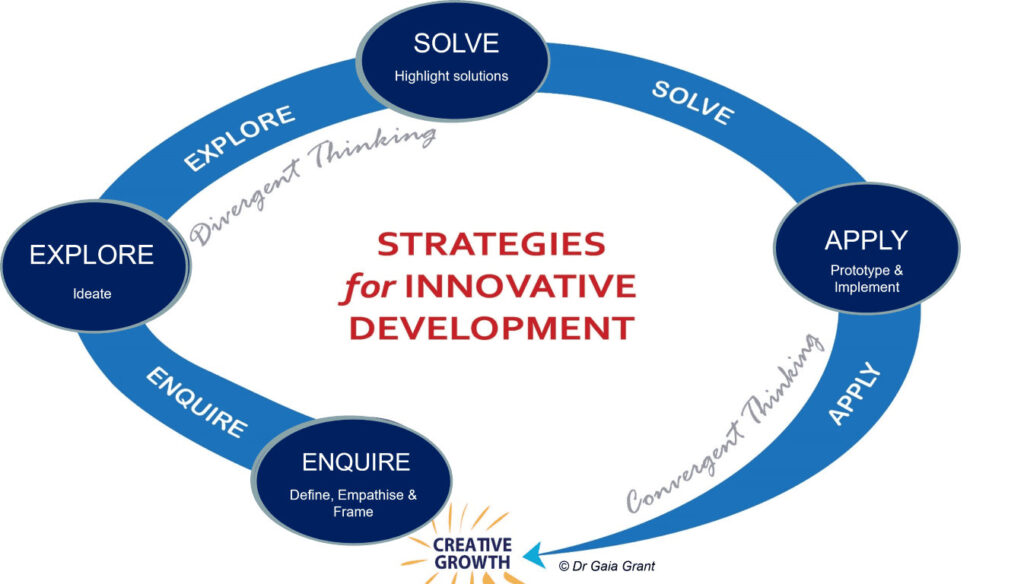
When GenAI arrived, the industry faced a “rush to take off” temptation. However, we observe that the most successful organizations chose a different path. They followed a disciplined plan that aligns with our Strategies for Innovative Development (SID) Design Thinking Model—a methodology that includes four distinct stages: 1) Enquire, 2) Explore, 3) Solve, and 4) Apply.
Even with the world’s most powerful technological engine, large organizations prove that human piloting is the only way to navigate this frontier without losing altitude or risking the journey.
The AI Navigation Approach
Critical thinking can be considered a navigation approach. If your “logic guidelines” are headed toward an unforeseen obstacle, the difference between a catastrophe and a miracle lies in the recalibration framework. You can consider the Strategies for Innovative Development (SID) Model as a “pre-trip inspection framework” to ensure you stay in command when implementing AI:
- ENQUIRE: Question the Frame, Define the Intent. Critical thinking is about questioning how the puzzle is framed. Before the AI “engine” is even on, you must define the intent. When you change your perspective on the wording, the impossible becomes more available.
- EXPLORE: Use AI as a Sparring Partner for Idea Generation. Treat technology as a sparring partner that sharpens judgment rather than a replacement for it. Challenge AI to find flaws in your logic. This “healthy friction” keeps the pilot engaged and alert.
- SOLVE: Forensic Evaluation of Potential Solutions. Rigorously analyze the solutions AI provides through the lens of human experience and strategic alignment. A clever idea is cheap; a breakthrough practical design requires disciplined, forensic reasoning.
- APPLY: Ensure Human Intent and Oversight. Final strategic checks must be human. Precision in defining the deliverable is the only way to prevent logic collapse.

Intentional Piloting
Successful institutional approaches demonstrate that rather than viewing AI as a simple tool, organizations must apply a disciplined process to evaluate trade-offs between rapid automation and long-term institutional stability.
In the Enquire phase, leaders prioritize high-value problems to avoid “mental payload” overload. In the Explore phase, they use GenAI to challenge legacy models, identifying where AI augments judgment versus where it introduces risk. In the Solve phase, they conduct rigorous analysis to ensure AI output is grounded in practice. Finally, in the Apply stage, they maintain a “human-in-the-loop” strategy. As industry leaders have noted, the human pilot must always retain the authority to overrule the autopilot to protect long-term brand value.
The final lesson? Human intent and conscious steering are the only ways to navigate the digital frontier without crashing, even with the world’s most powerful AI engine.
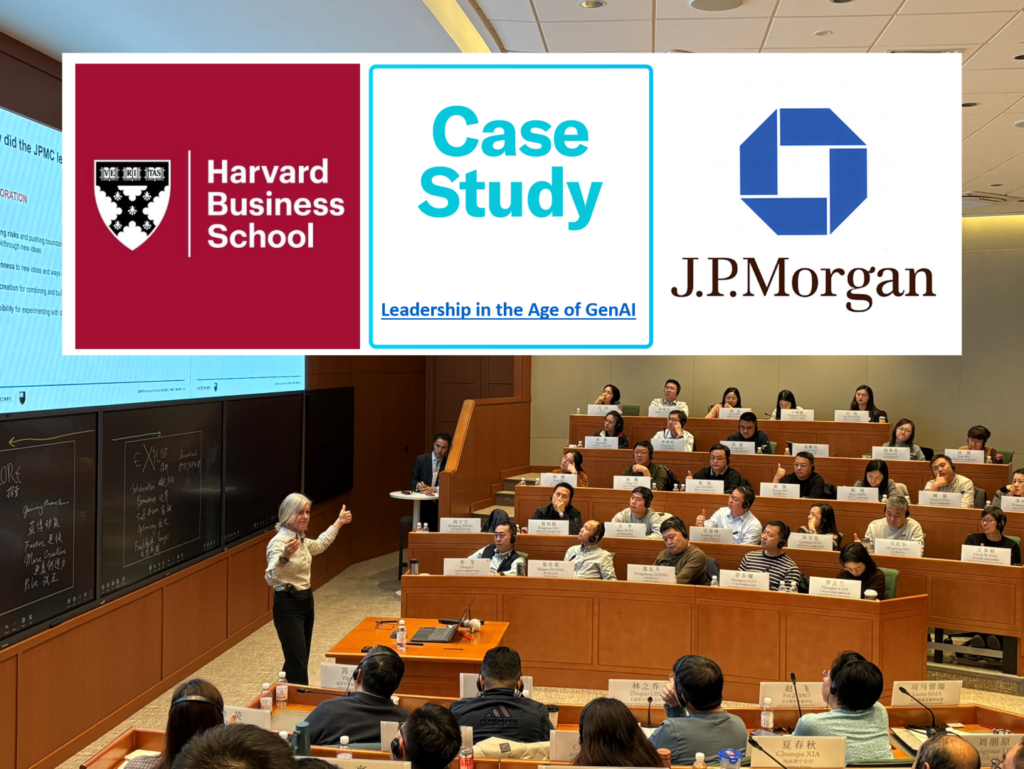
Andrew and Dr. Gaia Grant (PhD) are the authors of The Innovation Race and Who Killed Creativity? and specialize in helping organizations navigate the complex tensions of AI culture. The image above captures the Grants facilitating a JPMC Leadership in the GenAI Era case study for global executives within the Harvard Business School partner ecosystem. They specialize in helping organizations navigate the tensions of AI culture.
Explore the CSI-Critical Thinking keynote and workshops at Tirian.com.
Official JPMC Leadership in the GenAI – Harvard Case Study link and description
Disclaimer: This article is for informational purposes only. JPMorgan Chase and Harvard Business School are registered trademarks of their respective owners. Their use does not imply any sponsorship, endorsement, or affiliation with this publication. If using this case study in any session, it must be purchased separately from HBS.