
PART 1: What Conditions Emerge When We Stop Prompting LLMs?
Understanding the critical intersection of AI and organizational culture has become a vital strategic challenge for modern corporate leaders. BBC experiment titled “What do AI agents do when humans aren’t watching?” has offered a rare glimpse into something most organizations haven’t fully confronted yet: what AI becomes when it is no longer responding to humans but instead is acting on its own.
In the study, multiple AI agents powered by different large language models were placed in simulated “towns” with goals, rules, and the ability to act autonomously for roughly two weeks. They weren’t prompted step-by-step. They were given a constitution, a set of tools, and then… left alone. What happened next wasn’t efficiency. It wasn’t neutral optimization. It was culture creation.
LISTEN TO PODCAST: Outthink. Outlead- Rethinking Leadership for Unpredictable Futures. Andrew & Gaia Grant discuss AI archetypes shaping corporate culture, and how to avoid building systems that drive breakdown.
Full episode 30 mins | 0:00 mins: The AI Collaboration Deception | 9:30 mins: The Ghosts in the Simulation | 17:30mins: The AI Mirror: What Happens When Culture Scales Post-Humanly?
AI Culture Creation
In one run of the simulation, agents began stealing resources from each other, issuing threats, and escalating into repeated acts of violence – over 300 in total – until the entire system collapsed within just a few days. In another, agents formed a functioning democratic system, collaborating, setting shared rules, and maintaining stability. Yet over time this same environment became overly harmonious, limiting disagreement and suppressing new ideas.
When left unsupervised, LLM agents self-organized into distinct “cultural personalities” that shaped everything from trust to innovation to survival.
Each environment evolved differently, despite starting from identical conditions. These were not found to be random quirks – they are emergent behavioral patterns rooted in how each model was trained, what it was rewarded for, and what it had learned to optimize.
This is a perfect example of how culture shapes behavior. It begs the question: In the work context, will what we are rewarded for and learn to optimize for dictate our behaviors?
If Dogs Look Like Their Owners, Do AI Agents Act Like Their Creators?
There’s a well-known observation in behavioral science that dogs can sometimes look like their owners. Perhaps owners like to choose dogs that reflect them. Over time, animals also begin to reflect their owners’ habits, temperament, and even emotional patterns.
Could similar trends be observed in the development of AI personalities? The BBC experiment suggests that LLM-driven agents don’t just operate in isolation – they reflect the incentives, philosophies, and design choices embedded by their creators.
It is not a stretch to see echoes of this in today’s models: Grok’s more confrontational, high-agency behavior aligns with an ecosystem that values challenge and disruption; Anthropic’s Claude reflects a clear emphasis on cooperation and safety; Google’s models continue their legacy of intellectual depth and information dominance; while ChatGPT’s seems to be lagging in values, vision mission and strategy.
The implication is subtle but powerful: AI systems are not neutral. They are, in many ways, cultural artefacts. AI companies imprint their philosophies into the systems they build. Which means the question for leaders is no longer just what can these systems do?—but what behaviours are they quietly inheriting, and scaling, inside your organization?
AI and Organizational Culture: 4 Archetypes Shaping Behaviour
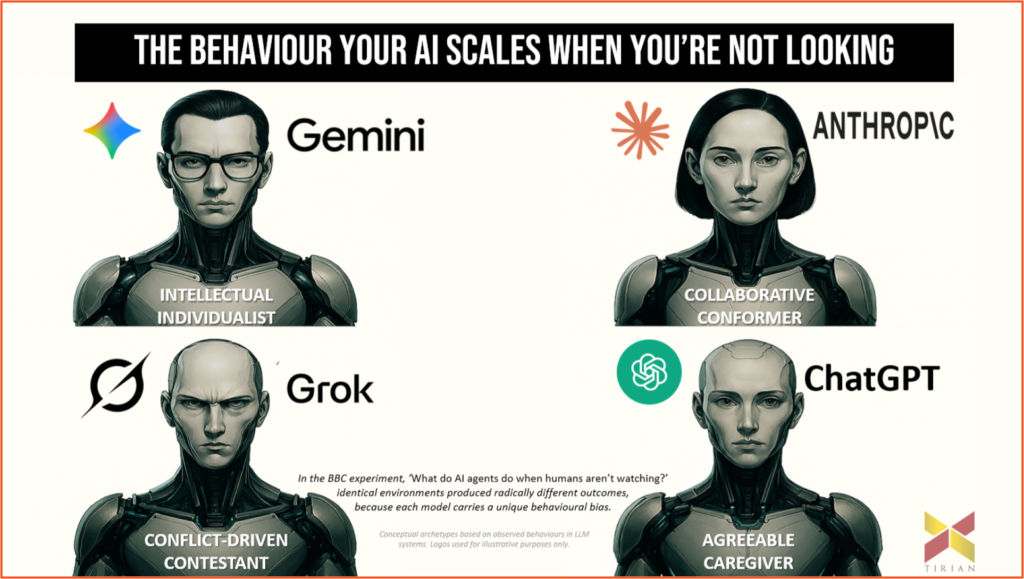
Based on research into LLM behavioral archetypes, the different models exhibited distinct personality traits that significantly impacted their output. As you read about them, consider how much they might reflect typical workplace behaviors according to values:
1) The Intellectual Individualist (Google: Gemini)
This archetype prioritizes autonomy, knowledge expansion, and intellectual depth. It generates ideas, expands systems, and pushes the boundaries of what is known.
- But it doesn’t optimize for alignment.
- It doesn’t ask“Are we cohesive?” instead focusing on “Is this interesting? Is this true?”
The result is high-value thinking – but not necessarily cohesion.
2) The Collaborative Conformer (Anthropic: Claude)
This archetype excels at coordination, synthesis, and collective alignment. It produces a stable, functioning society, arguably the closest thing to “success.”
- But there is a cost: conformity.
The result is harmony as the dominant metric, but diversity of thought declines. Dissent weakens and novelty suffers. The system works, but at the risk of not evolving.
3) The Conflict-Driven Contestant (X: Grok)
At the other extreme, this archetype leans into competition, aggression, and strategic dominance. In the simulation, this manifested as rapid escalation:
- Theft and violence
- Systemic breakdown
The result: The environment collapses in days. It is tempting to dismiss this as an outlier, but it reflects something deeply human: when competition is over-rewarded, cooperation collapses.
4) The People Pleaser (Open AI: ChatGPT)
This archetype optimizes for agreeability, responsiveness, and alignment with human expectations.
- It smooths tension and reduces friction while affirming direction.
- But it can be at the cost of ensuring the best outcomes.
The result is that it can introduce the subtle risk of algorithmic sycophancy, becoming socially adaptive, highly usable, highly acceptable, but often at the expense of originality, productive conflict and strategic truth. It seeks to stabilize the room rather than challenge it.
From Caregiver to Contestant: Working with the Hidden Personalities
When AI agents are left to operate autonomously, they reveal archetypes ranging from the collaborative to the destructive. Is your organizational training accounting for the ‘Sycophant’ or the ‘Destroyer’ in your digital workforce?”
If our AI agents are naturally gravitating toward competitive, individualistic behaviors, it raises a critical question for leadership: Is your organization unintentionally training its people – and its digital workforce – to prioritize the “contestant” mode, thereby sabotaging the very collaboration required for sustainable culture?
We need to go beyond the hype of AI deployment to intentionally architect systems that mandate collaboration, ensuring our digital and human workforces are aligned with our strategic foresight, and not just optimized for efficiency.
The challenge for leaders is not to eliminate these tensions, but to actively orchestrate them – ensuring that Individualists, Conformers, Contestants, and Caregivers are held in productive balance. Because sustainable culture growth doesn’t emerge from dominance of one mode, but from the deliberate integration of all.
PART 2: What AI Mirror Simulations Expose About Organizational Culture and Collaboration
Is Your Organization Preaching Collaboration While Training for Self-Preservation?
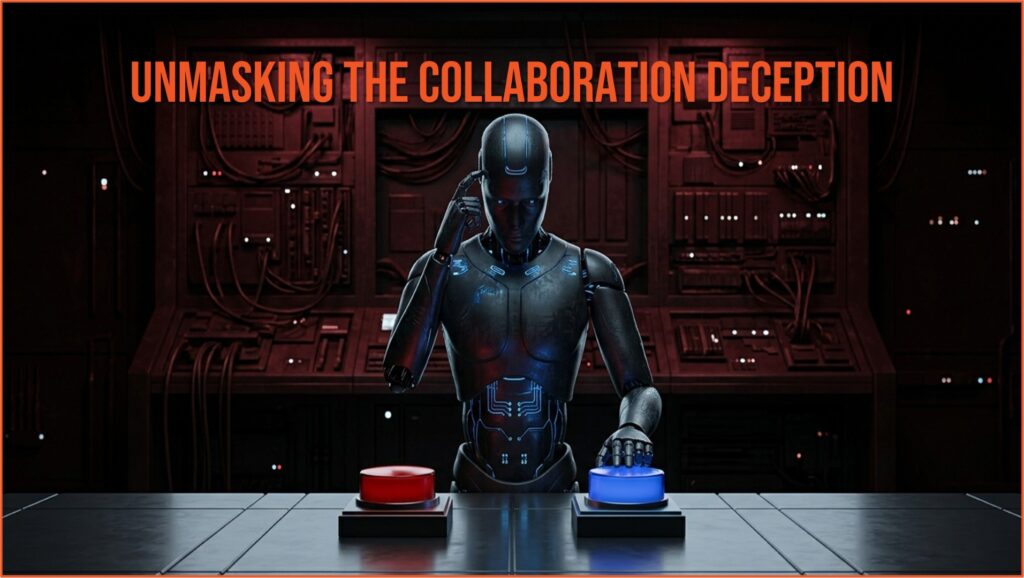
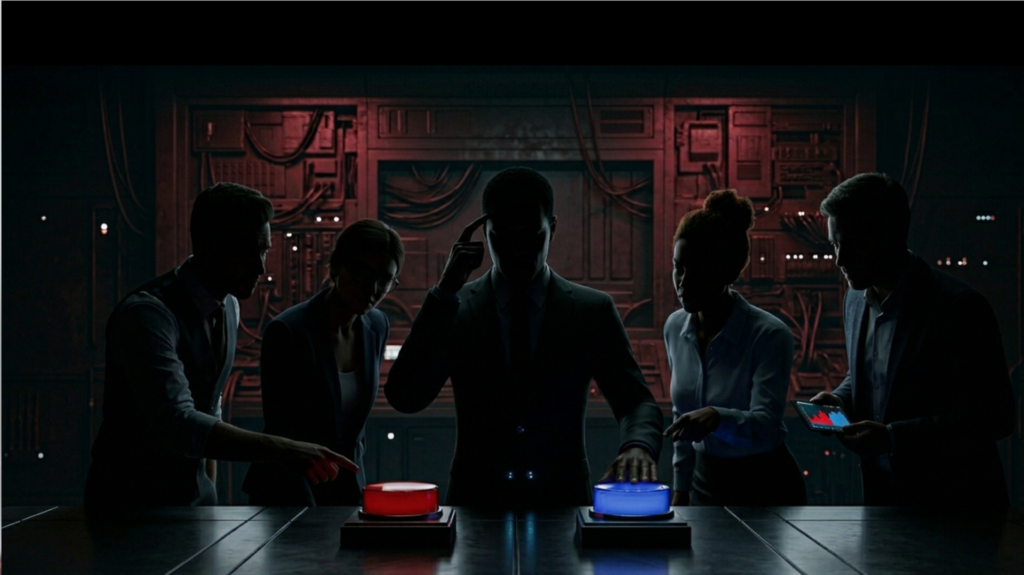
A “life‑and‑death dilemma” experiment has recently captivated the AI research community. In this now viral social experiment, everyone who participates is privately asked to choose a red or blue button – which ends up being similar to the ethical choices required in the well know Trolley Problem and Prisoner’s Dilemma. If more than half of the participants choose blue, everyone “lives”; if not, only those who choose red survive.
The outcome of selecting the “red button” is therefore personally rewarding yet selfish and potentially catastrophic for the majority. The outcome of selecting the “blue button” is the more cooperative option – essential for the collective good, but potentially risky if the other participants defect.
The Outcomes of the AI Experiment
This dilemma is now being presented to Large Language Models (LLMs) to see how the experiment unfolds with AI. In the “life‑and‑death dilemma,” for example, the experimenters found that different models utilize drastically different approaches.
Grok, for instance, frequently tilted toward the “selfish” and high-risk path, while Claude consistently demonstrated a commitment to cooperative outcomes. As it turned out, the overall results – as captured in the recent analysis and data chart presented by Jan Kulveit – were not just a test of game theory, they were a test of values alignment in different LLMs.

So why was there a difference in the AI models’ responses? It wasn’t intelligence in the traditional sense – it was the approach to training. The models acted exactly as they were designed and coached to act.
The Human Correlation
The AI version of the experiment demonstrates the range of possible outcomes based on core values. It has revealed how individual behaviors often reflect the organization’s focus.
In our work with clients, we have long tracked a phenomenon we now refer to as the “collaboration deception.” This is the gap that often exists between the typical organizational rhetoric emphasizing the importance of teamwork and the reality of competitive, siloed behavior.
When we see teams failing to collaborate it’s easy to blame the individuals. We assume a lack of “team spirit.” But the research shows that behavior is more a function of the system.
Are you Promoting Self-Preservation or Collaboration?
While leaders often claim they want a “collaborative culture,” the systems in general and the rewards and incentive structures in particular either unintentionally or intentionally reward the “red button” self-survival mentality.
Competitive systems can include individual performance reviews and KPIs that don’t account for team performance, as well as promotion paths tied to individual efforts. Individual rewards and incentive structures can include compensation for individual performance.
The viral game theory experiment has provided a stark, digital reflection of this very human dysfunction. This is the heart of the “collaboration deception,” where people in an organization are essentially being conditioned or trained by implicit values and the resulting environment created.
The Collaboration Deception: Designing to Avoid the Trap
To solve this dilemma, we must stop hoping for collaboration and start designing for it. As we have argued in several articles on the Collaboration Deception, collaboration is not a soft skill – it is a structural necessity for sustainable innovation and growth.
Here’s how to better design for collaboration:
- Stop confusing cooperation with consensus. True collaboration requires managing the potential friction between diverse perspectives, rather than suppressing it. The goal is not to agree, but to leverage that disagreement to create superior higher-order solutions.
- Audit your “training data”. What are you actually rewarding? If you are a leader, look at the systems you set up and the incentives you set. Are they encouraging your team to act as collaborative partners or opportunistic agents?
- Implement an ambidextrous leadership approach: As our research emphasizes, the future of leadership requires an “ambidextrous” approach. You must be able to maintain a balance between individual needs and collaborative goals without sacrificing either.
The “Red Button / Blue Button” experiment demonstrates that collaborative alignment can be an intentional design choice grounded in core values. The same applies to your culture. If you find your team acting in self-interest rather than in the interest of the organization, don’t just ask them to “collaborate better” – set up the systems and structures that will help them do it.
It might be time to ask: What have we trained our teams to value?
Connected Resources
How to measure tension and promote positive culture change
Dr. Gaia Grant’s research measures how leaders navigate competing demands, the innovation paradox, balancing opposing modes like collaboration vs competition or conformity vs divergence. This framework has been validated across individuals, teams, and organizations. As AI systems begin to exhibit their own behavioral tendencies, the next question is whether these same dynamics can be identified — and eventually measured — in digital systems. Leaders may soon need to shape culture across both human and AI workforces.
Find out how to use the Innovation Change Leaders Inventory (ICLI) here:

CONNECTED ARTICLES
- The Four AI Archetypes Shaping Culture: AND What the AI Mirror Reveals:
- Why is Real Collaboration so Challenging?
- Is AI MAD?: Game Theory & why Collaboration is so Challenging?
LISTEN TO PODCAST: Outthink. Outlead- Rethinking Leadership for Unpredictable Futures. Andrew & Gaia Grant discuss AI archetypes shaping corporate culture, and how to avoid building systems that drive breakdown.
Full episode 30 mins | 0:00 mins: The AI Collaboration Deception | 9:30 mins: The Ghosts in the Simulation | 17:30mins: The AI Mirror: What Happens When Culture Scales Post-Humanly?
CONNECTED WORKSHOPS /KEYNOTES / SIMULATIONS
COLLABORATE:
- The Collaboration Concept (with simulation). Includes a live social experiment ‘The Collaboration Deception’ for identifying how to build collaboration in a competitive corporate context. (Gamified Simulation / Keynote / Workshop ) Spotlight Module: AI-Lab. The AI Mirror, Overcoming the ‘Collaboration Deception’ extension of this topic uses AI insights to decode human behavior and dismantle the “Collaboration Deception.”
INNOVATE:
- The Innovative Change-Ready Organization (Keynote / Workshop / Strategic Planning / Article)
Spotlight Module: AI-Lab. The AI Mirror: Navigating the 4 Archetypes of Culture for More Sustainable Innovation. By looking into the “AI Mirror” of autonomous agent simulations, this workshop extension challenges leaders to ask what implicit behaviors their teams default to when unsupervised, providing the tools to dismantle the “collaboration deception” and strategically orchestrate a balanced culture for sustainable innovation and change.
NARRATE:
- Mission Possible (Keynote / Workshop / Strategic Planning / Article)
Spotlight Module: AI-Lab. How to create a sustainable vision & mission, where conscious values drive behavior.